Johan Svendsen
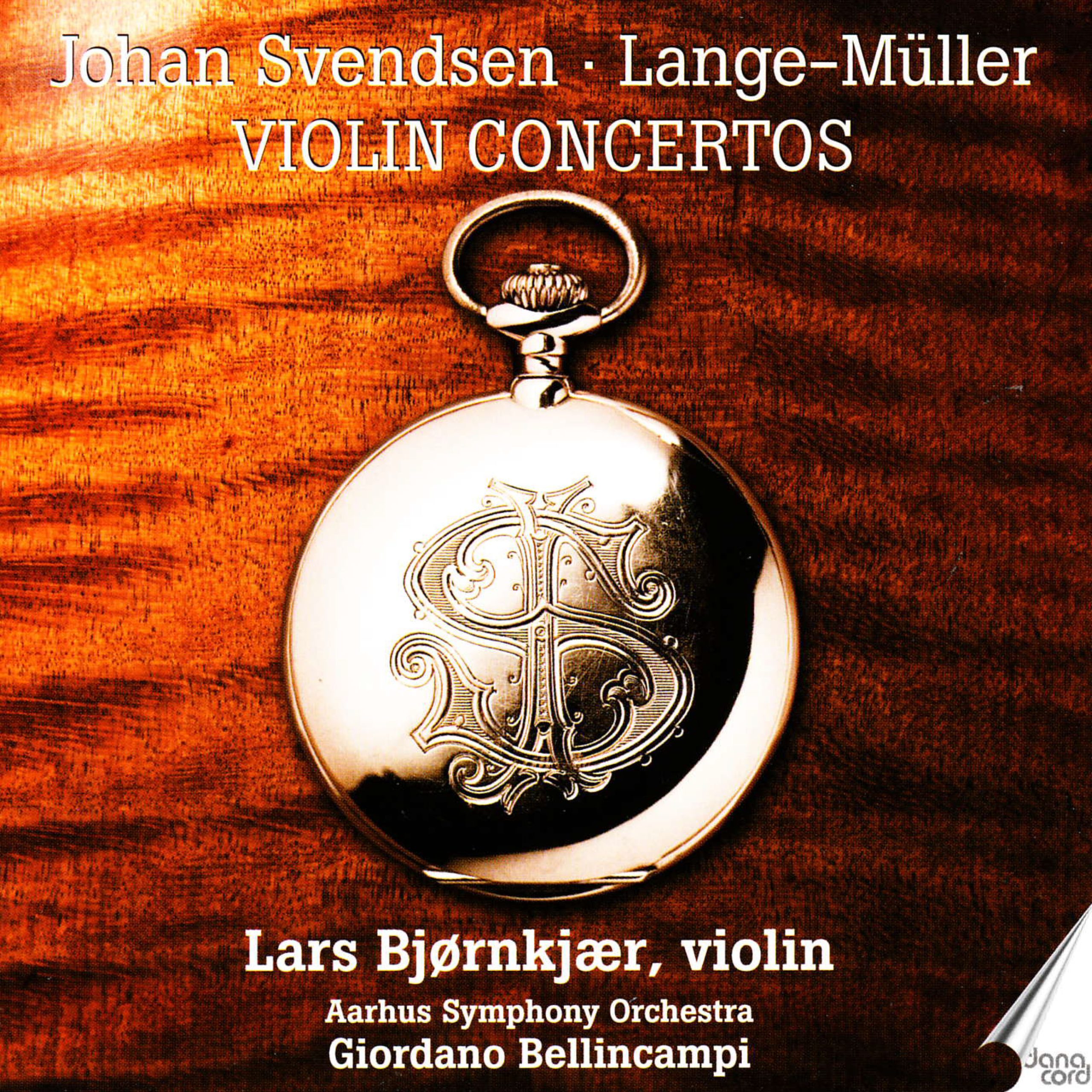
Concerto for violin and orchestra in A major, op. 6
1. Allegro moderato ben risoluto
2. Andante
3. Finale. Allegro giusto
4. Romance for violin and orchestra op. 26 (1881)
Peter Erasmus Lange-Müller
Concerto for violin and orchestra in C major, op. 69
5. Moderato (Cadenza: Lars Bjørnekjær)
6. Allegretto sostenuto
7. Allegro giocoso
Johan Svendsen & P.E. Lange-Müller ©
Travelling in music – describing Johan Svendsen’s life is like writing an account of a journey. He set off from his native town Oslo with his violin on his back in 1860 at the age of 22, and did not seriously settle down until 23 years later he became conductor at The Royal Theatre in Copenhagen. Johan Svendsen had a musical upbringing, he played in local dance orchestras already at the age of nine, and when he was eleven he composed violin pieces, dances and marches. His father was a regimental musician, and at the age of 15 Johan Svendsen joined the band of the commando troops, where he played the flute and clarinet.
But the violin was his greatest interest, and in 1860 he had to get away. He travelled through Sweden to Lübeck, where his money ran out. In his hardship he managed to get a Swedish-Norwegian consul in the city to obtain a scholarship for him enabling him to develop his violin playjng, and with this in the bag he travelled to Leipzig and entered the conservatoire there, which was the undisputed centre of European music, and where musicians from the whole of Europe went. Johan Svendsen concentrated on studying composition, because problems with his left hand limited his possibilities as a violinjst. As an energetic member of the music society of the conservatoire students he had several of his compositions performed, including the string
quartet, opus 1, the first symphony, opus 4 and the string quintet, opus 5. The string octet, opus 3, earned him the conservatoire’s first prize.
Having gained such considerable recognition, Johan Svendsen travelled further to Scotland, the Faeroe Islands and Denmark, and in 1867 returned to Oslo, where he was discovered by Edvard Grieg. In the following years he was active as a conductor and violinist back and forth between cities including Leipzig, Paris, Weimar and Bayreuth, where he was invited to play in the orchestra which under Richard Wagner’s baton was to play Beethoven’s 9th Symphony at the laying of the foundation stone of the FestspielHaus in Bayreuth.
“Lange-Müller, the musician”, he managed to stutter out, lying in the street after a fainting fit. He was taken to hospital, but died four days later of the injuries sustained by the fall and from an attendant pneumonia. It was the 22nd of February 1925; Peter-Erasmus Lange-Müller lived to the age of 75. He had modestly called himself “Lange-Müller, the musician” all his life, as if he had had difficulty in choosing precisely this occupation:” Why must one compose?” he once said to a friend; “There is after all so much excellent music – we don’t need any more!”
His mother, who died when he was 9 years old, had indeed let her children sing and occupy themselves with music, but already at the age of 4 Peter-Erasmus was ill and suffered aftereffects
in the form of more or less constant headaches. This handicap pursued him all his life and certainly hampered him in his musical activities and zest for life in general. The headaches meant among other things that he did not go to school until he was 17. At the same time his first song was completed – music had become an integrated part of his world.
But since Lange-Müller was from a family of civil servants, he decided to study political science, although he entered the conservatoire at the same time. Ill health however caused him to abandon both courses of study. For a time he trained as a gardener on account of the effect of fresh air on his headaches, later travelling to Norway in order to clarify his situation, but returned home and was inactive until he wrote in his diary in August 1874 at the age of 23, “Now I cannot go on, now I shall set sail towards the realm of art, boldly, madly with my wretched vessel. It is no use, I cannot do otherwise”. “Lange-Müller, the musician” had finally made up his mind, and for the first time had his music published: his opus 1, five songs from B .S. Ingemann’s” Shulamite and Solomon”.
It was a risky debut because the grand old man of Danish music. J.PE. Hartmann, had set the same poem to music twenty years earlier. A comparison was unavoidable, but Lange-Müller’s “wretched vessel” turned out to be quite seaworthy – he had already found his individual style, which not least together with his songs was to be a significant contribution to Danish music. Lange-Müller became a highly prolific composer. His pronounced interest in the theatre developed his dramatic awareness at an early stage, and this resulted in music for plays and several operas. Apart from this he composed works including two symphonies, orchestral suites, chamber music, piano pieces and not least developed a special Danish style inspired by folk-music in his theatre music and in his many solo and choral songs.
RELEASE DATE: MAY 2007
CATALOGUE NUMBER: DACOCD 662
EAN: 5709499662007