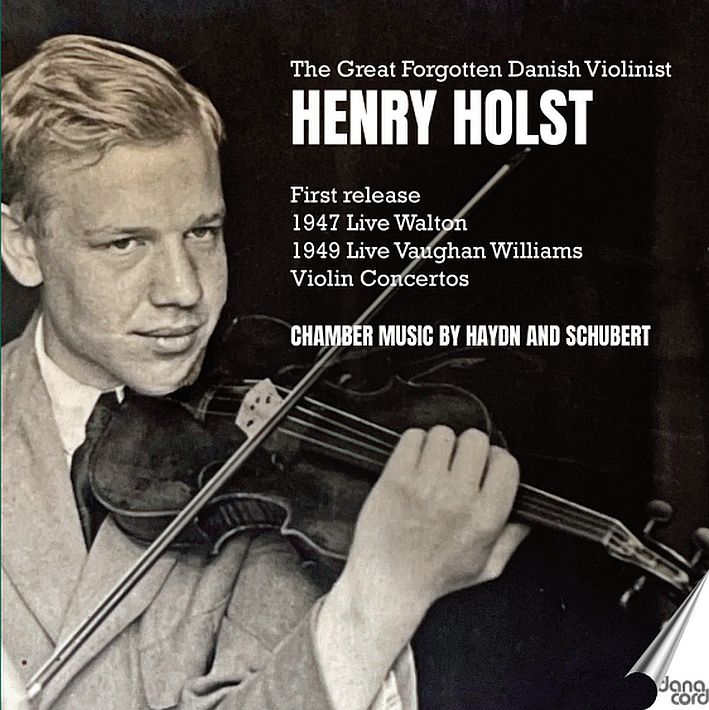
Review: Artamag
Review: DeutscherSchallplattenpreis
Review: FonoForum
Review: Gramophone
CD 1
Ralph Vaughan Williams
Violin Concerto in D minor, ´Concerto Accademico´ (1924-25)
1. I. Allegro pesante
2. II. Adagio
3. III. Presto
Frederick Delius
4. Légende in E flat major (1895)
William Walton
Violin Concerto (1938-39)
5. I. Andante tranquillo
6. II. Presto capriccioso alla napolitana
7. III. Vivace
Pablo de Sarasate
8. Zigeunerweisen Op. 20, (1878)
Fritz Kreisler
9. Liebesleid
CD 2
Franz Schubert
Trio for Violin, Cello and Piano in B flat major, Op. 99
1. I. Allegro moderato
2. II. Andante un poco mosso
3. III. Scherzo. Allegro
4. IV. Rondo. Allegro vivace
String Quartet No. 14 in D minor, D810 ´Death and the Maiden`
5. I. Allegro ma non troppo
6. II. Andante
7. III. Menuetto: Allegretto
8. IV. Allegro moderato
Joseph Haydn
Piano Trio No. 39 in G major, Hob.XV:25 ´Gypsy`
9. I. Andante
10. II. Poco adagio cantabile
11. III. Rondo all´Ongarese (Presto)
Henry Holst ©
In 1923 Henry Holst presented himself as a candidate for the leader of The Berlin Philharmonic, which after the death of Artur Nikisch in the
previous year now had Wilhelm Furtwängler as its chief conductor. He won the position over 14 competitors and relates himself:
“That was quite something for an enthusiastic young violinist! From the last desk of the second violinists on Kgs. Nytorv to the highly responsible first desk in Bernburger Strasse, enjoying a close working relationship with such a great figure as Furtwängler”.
Also in this orchestra he had many solo performances, but after eight years, in 1931, he was offered a position in England at the Royal Northern College of Music in Manchester, an offer which to many people’s astonishment he accepted. If the political developments in the Weimar Republic had not been, as far as one can judge, a deciding factor, then it was probably a strong motivation for his farewell to Germany, where his friends asked him what on earth he wanted to do in “ein Land ohne Musik?”
One should not be led into assuming that Henry Holst had family connections with England or English people, even though the name Holst might cause one to imagine this to be the case: one only thinks of the composer Gustav Holst.
About his farewell to Germany and his time in England he himself relates in a speech he gave at a commemoration at the conservatoire:
“I have never regretted taking that step. England was of course by no means without music. Many great names in the history of music have felt attracted to England: Haydn, Mozart, Weber and our own Niels W. Gade were active in England and benefitted considerably from recognition in that country.
RELEASE DATE: MARCH 2026
CATALOGUE NUMBER: DACOCD 1009
EAN: 5709499100905